
Welcome to The Connection,
NASAP’s Online Newsletter
July 2026 Issue
Dear Fellow Adlerians,
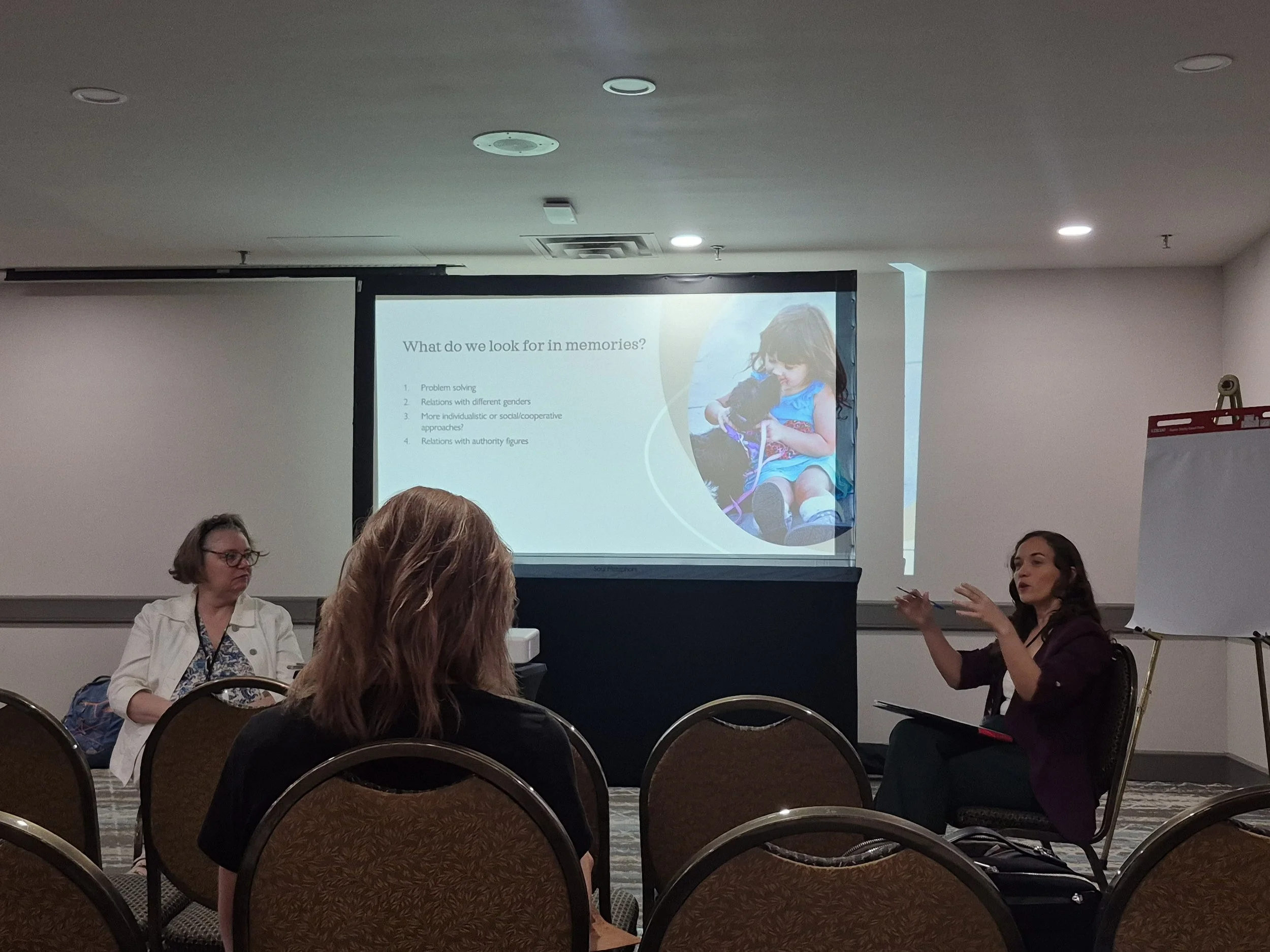
As I write this, I am only now coming down from the high of attending the 74th annual conference in Minneapolis. This was my second NASAP conference, and the first one at which I have presented. I was thrilled to offer a workshop and a three-hour training together with Miosotis Cotto on Exploring and Preserving Adler’s Unpublished Method of Lifestyle Assessment. The questions raised by attendees and the interest they showed in the method were truly rewarding.
Additional highlights for me included attending a workshop by Kay and Jean Kummerow on linking the MBTI to the Crucial C’s and a workshop by Len and Jon Sperry on Adler’s classic case study of Mrs. A. The Sperry’s workshop featured a special appearance by A.I. Adler. I also enjoyed a cooperative games session facilitated by Marjie Longshore. Tim Hartshorne’s Ansbacher lecture was beautifully personal and moving. One shocker was walking into the lobby and seeing my picture on a poster for those receiving the President’s Award. My thanks go to Hallie M. Williams for extending me this honor. As someone who only joined NASAP three years ago, the conference also offered a wonderful opportunity to meet new people and to connect with recently minted Adlerian friends.
Please enjoy the July issue of The Connection. I wish you readers all the best in finding your own connections to the broader Adlerian community, whether through conferences, trainings, collaboration, or other means.
Sincerely,
Ellen Alderton, Editor
President’s Message
Ben Rader, Psy.D.
On the Promotion of Adlerian Knowledge
“To promote the knowledge, training, and teaching of Individual Psychology, defined as the psychological theory and practice originating with and so named by Alfred Adler”
Hello, NASAP Community!
I am both honored and excited to be beginning my role as NASAP President. I have much appreciated the support that I have had in our past president, Hallie Williams, and remain comforted to have him in this role to support and guide my stewardship in this role (thanks, Hallie!).
On purpose
As I look forward to the two years ahead of me, I find myself recurringly drawn to one simple concept: purpose. Purpose is important to Individual Psychology, and it thereby also has become of great importance to me, so much so that I have named my private practice after it: Psychological Purposes.
At the heart of the human experience, is that singular, evolving, at times hazy but always present question, “what is my purpose?" This question continues to draw out the trajectory of my own life movement; in whatever chances or opportunities I find myself pursuing. However, in the context of my presidency, the question shifts a bit from “what is my purpose?” to "what is our purpose?” For NASAP, there is actually a definitive answer to this. Our purpose is expressly identified in article II if our constitution. Section 1. of article II states “The purpose of the North American Society of Adlerian Psychology (hereinafter referred to as NASAP or the Society) shall be,” and then it goes on two identify a total of eight distinct items, constituting our shared purpose.
Item 1
Beginning with this submission and throughout my future issues, I will be using my presidential posts in The Connection to outline what I see as the tasks at hand, in our realization of our purpose (more accurately, purposes), through the actualization of our eight respective aims.
I begin with the first item: to promote the knowledge, training, and teaching of Individual Psychology, defined as the psychological theory and practice originating with and so named by Alfred Adler.
A community of teaching, training, and knowledge
NASAP, undoubtedly, is a community of knowledge, training, and teaching. I can remember my first conference and walking away from it like I had my brain rebooted. In fact, I have continued to experience something like that at every conference I have attended ever since. This past year in Minneapolis was no exception. My annual dosing of concentrated Adlerian perspectives left me reeling and rejuvenated for another year. Better still, since I was fortunate to be able to bring friends and colleagues along with me this year, I was able to appreciate witnessing a similar impact that the conference had on each of them.
However, despite my strong appreciation for this annual pilgrimage, I have found myself vexed by an unsettling realization: There aren’t enough of us. Suffice it to say, NASAP remains the best kept secret in ever growing landscape of professional trainings.
However, keeping Adlerian concepts a secret is NOT what we have outlined in the second article of our constitution. It is our charge to promote knowledge, training, and teaching of Adlerian psychology. This means that we need to be able to share its growth outside of the closed circuit of our Adlerian community.
Training galore!
To be sure, it is not for the sake of Adler that we must be compelled to promote his legacy, but for the sake of the world in which we live and serve. As I sift through the growing stack of training offerings that get sent to my business office and home each year, I find myself taking careful note of the themes that organize what is being offered; evidence-based practices for specific conditions, considerations in serving specific types of clients or demographic groups facing certain types of hardships like war exposure or social exclusion, trauma-informed care, approaches catered to certain personality disorders, and interventions based on our emerging and ever growing understanding of the brain. Most of these offer clear and distinct values with irrefutable insights, and we are fortunate to live in a day and age where so much content is available to us.
Yet, as we delve ever deeper into the treating of disordered personalities, brains, and specific demographic groups, it seems there are core components of the human experience we are missing. With all this information at our disposal, are we any more knowledgeable about ourselves or our relationship with others and the greater world, or how these very matters relate to the manifestation of suffering and “pathology” to begin with?
On knowledge
This begs the question, what is knowledge, and what is the purpose of pursuing it?
Once again, there is a tangible answer. In her classic essay, Education for Freedom, Lydia Sicher characterizes knowledge as a tool. Knowledge is not so much a thing to be had, as it is a potency that can be enacted. According to Sicher, “the most worthwhile knowledge anyone could acquire would be to know that only in togetherness and interdependence can the individual accomplish...self-realization” (Sicher, 1954 in Davisdson [ed.], 1991). Perhaps this is what is missing now from so many popular professional trainings. Perhaps this is what is underlying the “rebooting” that I experience at our annual conference.
As the zeitgeist of teaching and training becomes increasingly technocratic, directed by specialized experts touting replicable interventions on subjects “in need,” the agency and humanity of those we serve get eclipsed in our “treatment” approaches. Even more concerningly, this trend may reflect an occlusion of a genuine knowledge of self as our professional trends in the end serve to alienate human awareness from human community and connection.
If this is the case, our charge to bring Adlerian perspectives into the world remains all the more important, and all the more daunting. How do we make Adlerian perspectives relevant during a time when we have parceled out “treatment” approaches from the broader contexts in which human experience is lived out and encapsulated? What strategies do we use to entice today's students and scholars to take a new look at this century-old approach? How do we proceed when professional guidelines around training require contributions from the past seven years? What do we do with the decades-long insight and knowledge they have established in Individual Psychology, if there are no new people to share it with?
Call to action
The fact that we remain unique and different from the broader trends does not need to make us seem irrelevant. Rather, because of our distinctiveness, we may now offer a desperately needed value and significance that the world is unknowingly starving for. But if we are going to make good on our constitutional priority to promote the knowledge, training, and teaching of Individual Psychology to current and future generations, we have work to do. We need to continue our efforts promoting Adlerian perspectives in the universities, professional schools and training institutions we are already affiliated with, as well as finding new ways into other existing institutions. We will need to develop training content and promote access to existing resources we have in Thinkific, Tap Talks and the Daily Adler (to name a few). We also need to promote and disseminate existing Adlerian texts, as well as continue writing new texts that will be relevant and appealing to new scholastic audiences.
Organizationally, we will need to be even more intentional and strategic in how we function, to make sure that in addition to maintaining our current NASAP membership, that we can support the regional initiatives that continue to take place in Georgia, Idaho, Toronto, and other places, and to begin developing new opportunities to teach and train in new regions.
For sure, our existing sections and affiliates will need to play a role in this, and we as an organization need to promote and share the initiatives of professional clinicians and Family Education Sections (in particular) who are already offering recurring education and training experiences that we continue to offer over the year. But perhaps the most important work is still what remains to be decided.
Your part in this
If the promotion of Adlerian teaching and training interests you, there are important position vacancies on the Committee on Education and Professional Development. We could also use ongoing support on the Long-Range Planning Committee, as our priority for teaching and training really may best be considered as longer-range initiative. We are also interested in hearing from any members who are currently affiliated with a professional school, university, or training institution who would be interested in developing networking strategies and initiatives targeting students and future clinicians in ongoing training in Adlerian psychology. I would love to hear from anyone interested in helping NASAP develop training curriculum that would be appealing and relevant to new students, as this has become a particular focus of my tenure as president.
If this has stimulated any thoughts or ideas, please do not hesitate to reach out to me directly at Rader.Benjamin@wspp.edu. The colony is always wiser than the individual bee. So, as I work to divine my own purpose as president relative to this first goal, I invite you all to align with me shared effort, imagining and then realizing together “what might be” as we act together in serving our calling as Adlerians.
Sincerely,
Ben Rader, Psy.D., President, North American Society of Adlerian Psychology

Updates from HQ, July 2026
By Susan Belangee, Ph.D., NASAP Executive Director
This year’s conference was another amazing event, with almost as many first-time attendees as returners and close to 200 people across the weekend. While I am still in recovery mode and tending to post-conference tasks, I am grateful for the chance to say thank you to a number of people who truly helped to make the conference a success:
To Miosotis Cotto-Lopez – a HUGE thank you for another amazing job coordinating the volunteers. It has been a blessing the last two years knowing you were handling the outreach and training leading up to the conference. You’re leaving some big shoes to fill (if anyone reading this wants to help with the volunteer coordinator position, contact the office at executivedirector@alfredadler.org).
To all the volunteers – we truly cannot run the conference without your assistance in all the various roles across the conference. From room monitoring to the bookstore and registration, I appreciate your time and efforts!
To all of the presenters – without you there is no conference! Thank you for contributing your time, talents, wisdom, and energy to make the 74th Annual Conference a fantastic experience for the attendees! We hope you will submit a proposal for next year, our 75th! The proposal form will be up on the website soon!
To my older daughter, Cathryne – thank you for accompanying me on a cross-country trek and stepping into whatever position I needed over the week of conference. You’re a beautiful, kind, and giving soul and I love you so very much!
For anyone I’m forgetting to thank, please know you made a good contribution, and I hope you continue to step in and step up in equally amazing ways in the future.
Now on to the exciting news; Many of you are anxiously waiting to hear the grand total of what we took in from the live and silent auction as well as the website donations. The grand total is ….
$11,130!!!!
This means that next year we will have even more money to offer scholarships to those who need financial assistance attending the conference! A final HUGE thank you to all who donated or purchased a live or silent auction item. Your generosity makes a direct and significant contribution!
Be in touch with any questions or issues you may have, and I shall do my best to answer as promptly as I can.
Thank you,
Susan
Earn Free Continuing Education Credits
The free continuing education article for this month is:
Birnbaum, F. (1935). Development of character. International Journal of Individual Psychology, 1 (1), 67-75. [0.8 CE hrs]
The focus of this article is on techniques for character development, which Birnbaum (1935) defines as increasing the likelihood that a person will strive for recognition within the “comprehensive community of mankind” and not within a “seeming community” or in “comparative isolation” (p. 68), in other words, increasing social Interest. A process of “assembling conclusions” to develop a formulation is described, and the “Perhaps you have believed …” question is proposed as one strategy for verifying these hypothesized formulations about a student or client.
Ferdinand Birnbaum (1892 – 1947) was trained as a secondary school teacher. He met Adler in 1920 and became active in Viennese Individual Psychology. From 1924 to 1934 he participated in the Individual Psychology Experimental School with Oskar Spiel and Franz Scharmer. During World War II he belonged to an illegal individual psychological working group, and after the war tried to revive the Association for Individual Psychology in Vienna.
Our thanks go to Rocky Garrison, Ph.D., who thoughtfully selects the readings for CE credits in each issue.


NASAP Section Update
News from the TRT Section (Theory, Research, and Teaching)
The Theory, Research, and Teaching Section (TRT) encourages the theoretical development of Alfred Adler's Individual Psychology through scholarly research and the teaching of this orientation at the undergraduate and graduate levels. We provide symposiums and presentations, facilitate meetings at our annual convention, and support one another as we extend the scientific and academic frontier of Individual Psychology.
TRT hosts meaningful events to help Adlerian professionals interested in theory, research, or teaching understand and apply Adlerian principles in a variety of settings. One of our signature events is the TAP Talk. TAP Talks are presented several times each year as a way of staying connected with NASAP members and as a way of providing an opportunity for continuing education hours. Recent TAP Talks have included Susan Belangee, Dan Kaufmann, Mary Simmerling, Natalee Bigger Stockdale, Kent Burtner, Chip Schooler, Michelle Griffith, Mandy La Guardia, Pascale Brady, Dan Williamson, and Jennifer Nivin Williamson. If you are interested in presenting a TAP talk, please reach out to TRT.
Outgoing TRT Co-Chairs are Daniel and Jennifer Williamson. Ken McCurdy will be one of the incoming co-chairs.
When you join NASAP as a member, or renew your membership, there is an option to join any section. If you would like more information concerning TRT, or if you have any questions, please email TRT at nasaptrt@gmail.com
Apple Pie Communications, a firm led by Ellen Alderton, offers consulting services in:
Grants: Ellen has won funding for numerous mental health projects including $1.25 million from the Lilly Endowment and $575,000 from SAMHSA. Besides grant writing, she can support project conceptualization and design, build out budgets, and suggest and bring on project partners.
Writing and Editing: Ellen can research and craft compelling language for websites, press releases, funding reports, annual reports, and more. She has edited newsletters for NASAP, Mental Health America, the National Association of State Mental Health Program Directors, and other organizations. She has worked as a reporter in Brussels, an educational radio producer, and as a technical writer for the United Nations.
Lifestyle Assessment: Ellen learned a method of lifestyle assessment passed down verbally from Adler. She has lectured on this technique for NASAP, the UK Adlerian Society, and the Adler Institute in Suisse Romande. She offers private lifestyle consultations as well as training in the method.
To learn more, visit https://applepiecommunications.com/ or write to ellen.alderton@yahoo.com.

Adlerian Creative Piece
ME.... WITH YOU ALWAYS
Behind you, in front of you, next to you
By Shazia B. Imran
8 years ago…. I came to know you… but didn’t understand who you were what you did, how you felt?
I still think about you when you walked in my office, wearing a beautiful shawl.
I still feel you when I look into your eyes and saw you were staring at my office wall.
I still see you when you cried and put the pillow on your lap.
I still hear you when you were angry and loud and often snap.
I still hear the sounds of your stories that you once told.
I still smell the fragrance of the candles while your stories were unfold.
I do want to tell you that I am behind you to always encourage you.
I do want you to know that I am standing right next to support you.
I promise you that I am in front of you to lead you in the life process.
I remind you though I am far away now but still celebrating your success.
I still remember saying your name “Jewel”
My dear Jewel…... you are a brave girl…...
My wonderful first client...My reminder of the four C’s
My courage, my commitment, my connection, and my competence ……
This piece was inspired by Adler’s belief in social interest and the courage to be imperfect. Jewel’s story reminded me that showing up authentically and walking beside our clients in where healing begins.
— Shazia

Interview with NASAP’s Mexican Affiliate Group
By Miosotis Cotto Lopez and Laura Carillo
Lea la versión original en español de esta entrevista aquí.
This affiliate group holds a very special place in my heart. The past president, Hallie Williams, and I dedicated a great deal of time and effort to opening communication channels and building the tools necessary to make it a reality. Seeing everything they have accomplished since then has been a truly rewarding experience. In this interview, we speak with Laura Carrillo, representative of the NASAP Affiliate Group in Mexico. - Miosotis
Miosotis: What was the motivation behind creating this affiliate group?
Laura: In Mexico, there is very little information available about Alfred Adler's work, even though many current psychological and social approaches align with Adlerian thought—particularly with the concept of Gemeinschaftsgefühl (social interest or community feeling). Our desire to join NASAP stems from the goal of building a relationship of continuous learning that allows us to spread Adlerian psychology among professionals in our country. We are a multidisciplinary group composed of psychologists, a marketing specialist, a nutritionist, educators, and a human rights professional, all united by a shared interest: to keep learning about Adlerian theory and to share it with others.
Miosotis: What have you accomplished so far?
Laura: Before officially establishing ourselves as a NASAP chapter, we collaborated with professionals from other countries to organize the 1st and 2nd Latin American Congress of Adlerian Psychology, both held online. We also worked on translating the Manual of Adlerian Principles by Zivit Abramson, a document that the author generously donated with the purpose of expanding knowledge of this approach in Spanish-speaking countries. Additionally, this year we had the pleasure of hosting a book club discussion on Diving into the Pool with the author herself, Dr. Anabella Shaked. At the same time, our group is enriched by members from Latin America and Europe who share our quest for Adlerian resources and materials in Spanish. Consequently, we frequently share learning spaces with other groups, fostering continuous development for our members. Recently, we joined forces with the Family Leadership Center affiliate group, offering some of our members the opportunity to complete their certification in the Four Cs in Spanish with Dr. Amy Lew and Marjie Longshore.
Miosotis: What are the future goals for this group?
Laura: We aspire to invite to Mexico those Adlerians who have inspired us to transform our professional paths, so they can share their expertise with our community. We are confident that, by then, a wider range of Adlerian literature will be translated into Spanish, allowing participants to take home more resources for their own continuous learning.
This interview was translated from Spanish with the assistance of Gemini, AI collaborator.
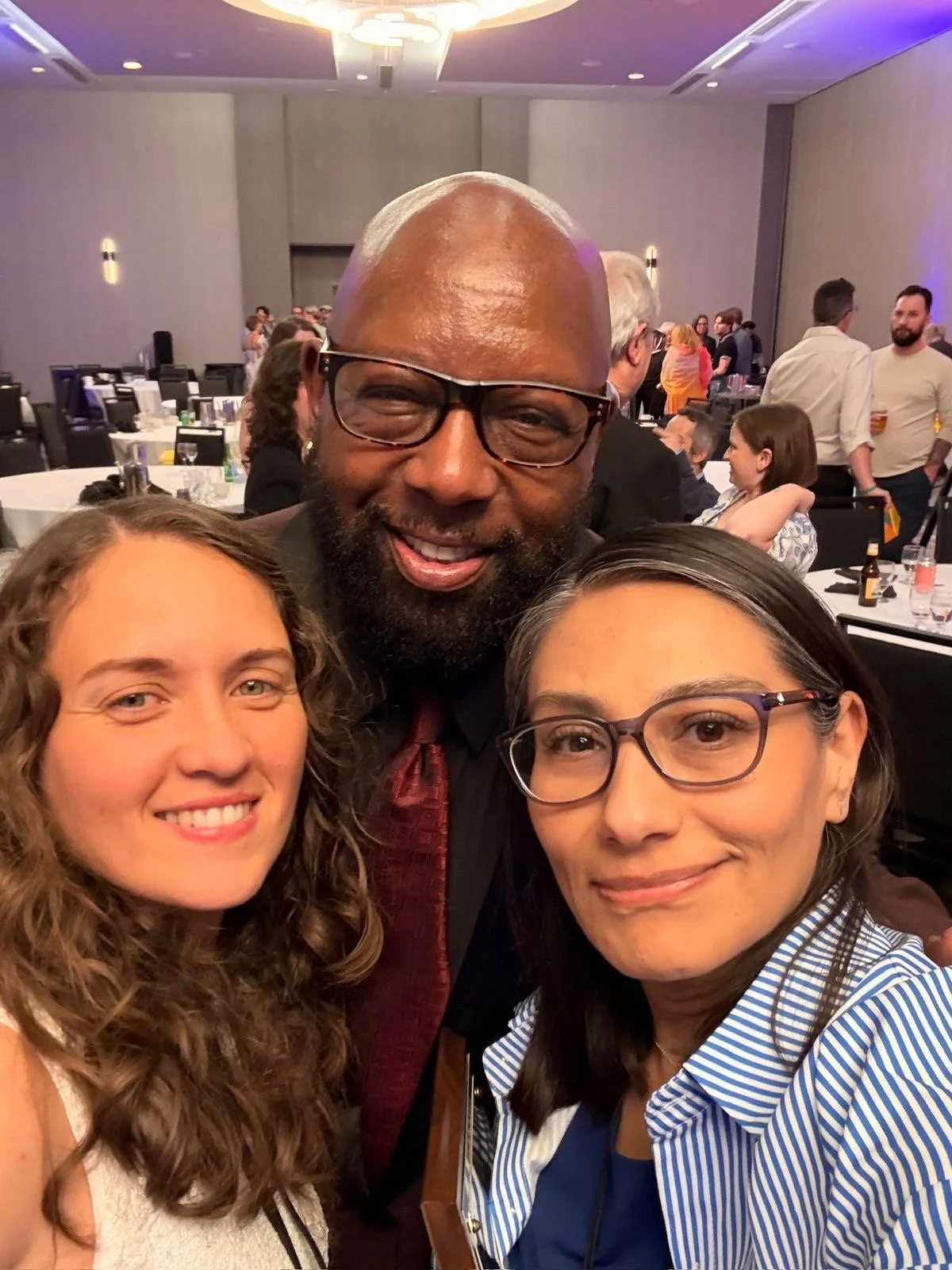
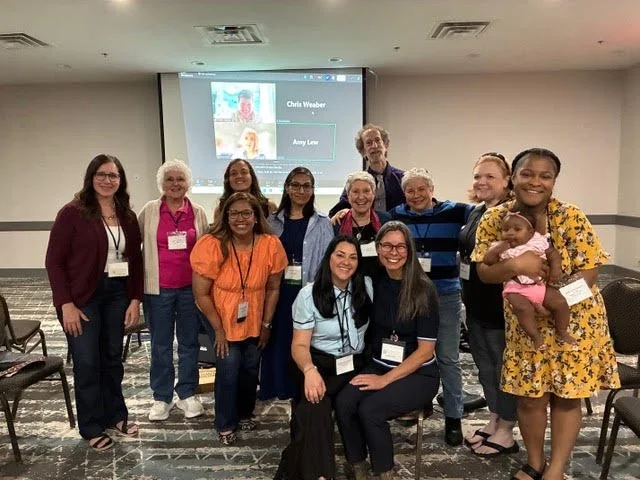
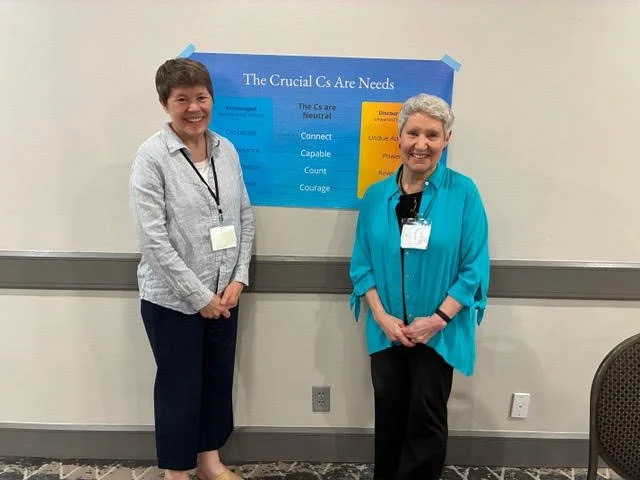
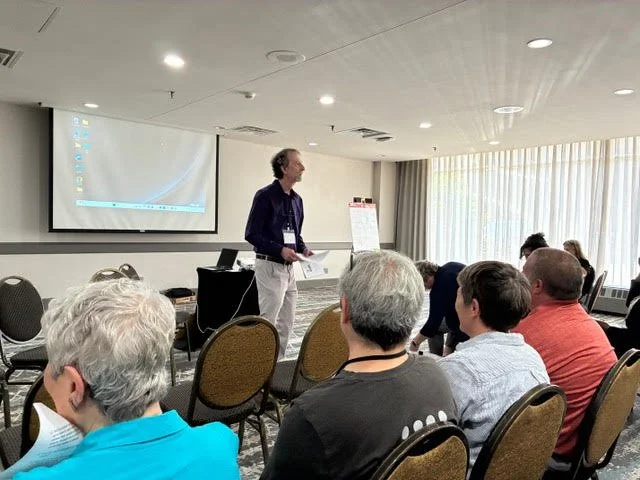
Family Education Section Gathers at Annual Conference
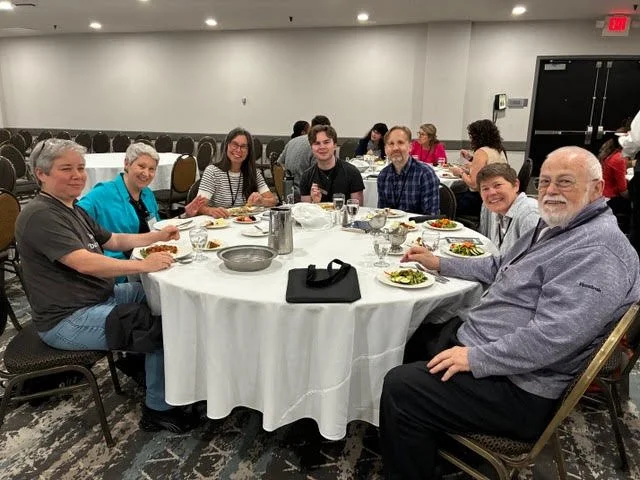
The Family Education Section (FES) had a great turnout at the 74th Annual conference in Minneapolis, filled with new and renewed friendships, learning and laughter.
While, thanks to our “retiring” Co-Chairs Marjie Longshore and Bob Saxner, our group has been meeting monthly online for several years, getting acquainted and sharing expertise, the experience of being together IRL was important and fortified connection. Warm welcomes were the keynote atmosphere at the conference.
Thematically, Family Education Section members couldn’t have been more pleased with the many options related to our sphere of interest and beautifully presented by our members.
The “Crucial Cs” (a concise summary of Adlerian principles of connect, count, capable and courage) had a starring role in several sessions.
On Friday, Marjie Longshore stepped in for Bob Saxner, who unfortunately had unexpected surgery and could not attend the conference, to join Amy Lew (co-author of the Cs) addressing “Beyond the goals of misbehavior:…”
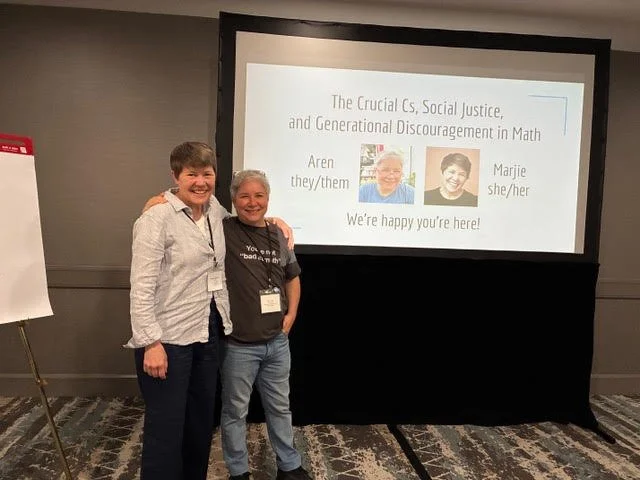
In a two-session opportunity led by Marjie with Aren Lew, the Cs were further explored, expanding parenting orientation to social justice/generational discouragement and math challenges.
Long-time FES member Rob Guttenberg taught his classic “Two Points On A Line” with a lifestyle assessment volunteer, who became an FES member.
On Saturday, Lindsay Hill and Joe Cice presented on the “Crucial Cs as a Compass” enhancing couples counseling. Basic Adlerian ideas about the need to belong (connect), improve (capable), be significant (count), and feel encouraged (courage) were explored in demonstrations.
FES members Gredder Rios-Lorenzo and Miosotis Cotto (substituting for Bob) led a compelling session on Cs-informed methods of dealing with “Neurodivergent, Deaf and Multicultural Communities.” (Later, Gredder and Mio agreed to further their service to the FES by taking on Secretary and Treasurer roles.)
Many FES members have become affiliated through training in Positive Discipline. A session led by PD trainer Kelly Pfeiffer on teaching adult learners was filled with experiential teaching activities imbued with social interest and cooperation.
A plenary session with venerable Adlerians discussing strategies in understanding and treating clients with substance issues also resonated with our family educators. An Open Forum demonstration of couples counseling with Calvin Armerding reinforced the basic principles all of our FES programming embraces. Calvin’s inclusion of Frank Walton’s “most memorable observation” query paid homage to one of the great losses in our ranks this year.
Not every activity was purely educational, of course. Adlerians know how to have fun! We gathered at mealtimes and took part in recreational activities.
During Cooperative Game Night, several of us played "Keep On Track" by Ted Wohlfarth at EnTeam. We had fun working together to move ping pong balls across multiple tracks quickly using creativity, teamwork, and communication. We all worked together, trying various methods in an attempt to increase the score of both teams. It was very exciting and we had a lot of laughs as "we learned to win together.”
The Family Education Section meeting was its own celebration with a fitting tribute to the leadership of Bob and Marjie, who had to leave for home before the conference was over. There was enthusiastic embracing of new members, and welcoming of new Co-Chairs Holly Weaber (formerly our Secretary) and Hollister Hunt. Due to the very helpful Zoom arranged by Holly’s husband, Chris Weaber, Marjie and Hollister (who lives in Rwanda) joined us fully.
We are energized by the competence and enthusiasm and willingness to make things happen in the generation coming up. With Marjie’s Family Leadership Center generously continuing to offer Zoom as a resource, FES plans to continue our monthly meetings, building community and expertise. Moreover, seasoned and recent members plan to increase outreach via social media and proposed the next conference’s Open Forum demonstration to illustrate classic family education principles and practices.
Looking forward to 2027 in Dallas!

Social Interest in Everyday Life
By Harshdeep Kaur, NASAP Intern
Human nature is fundamentally shaped by social interest, which impacts our daily interactions, connections, and concern for others. Social interest influences not only how we live, but also how we impact other individuals and society at large – from our small acts of kindness to our larger contributions to creating strong communities.
The term, social interest, describes people’s innate propensity to care about other people, give back to society, and experience a sense of community. The idea was first presented by Adler in 1927, who emphasized the importance of social interest for mental health and personal development. Adler asserts that people have better and more satisfying lives when they are involved in their community and concerned about the well-being of others. Put another way, social interest assists people in discovering meaning and purpose that goes beyond mere personal wants.
Adler’s century-old concept of social interest (Gemeinschaftsgefühl in German) seems more pertinent than ever in a world where social disengagement, loneliness, and self-centeredness frequently make the news. Adler held that genuine mental health, beyond our personal well-being, is derived from our ability to connect with others, make a positive contribution to society, and have a meaningful feeling of belonging.
How can we apply this theory to real-world situations and, more significantly, how do we quantify something as nebulous as “interest in others?” Psychologist, James E. Crandall, addressed this question in his seminal work, “Adler’s concept of social interest: Theory, measurement, and implications for adjustment,” published in 1980. His work provides fresh tools for researching Adler’s original hypothesis.
Measuring Social Interest
Crandall created the Social Interest Scale (SII), a self-reporting tool, to measure social interest. Items on this scale assess a person’s empathy, helpfulness, and sense of social group belonging. Crucially, Crandall evaluated the scale on sizable populations and discovered that lower levels of anxiety, sadness, and self-centeredness were consistently linked to greater social interest scores. The scale’s correlation with people’s regular habits is what makes it so fascinating. People with higher social interest scores, for instance, are more likely to volunteer, show concern for friends and family, and report greater life happiness. Conversely, people with low scores frequently display more solitary, competitive, or avoidant tendencies. Crandall’s work supported Adler’s theory that psychological suffering could be exacerbated by a lack of social interest.
Implications of Crandall’s Study
According to Crandall’s research, social interest is something we can cultivate and witness in the real world. It is possible that fostering social interest can protect against contemporary stressors such as burnout and loneliness. Practicing social interest contributes to the creation of robust, meaningful lives, whether via deeds of kindness, community service, or just being more sensitive to the needs of others.
Additionally, Crandall’s research provides opportunities for educators, counselors, coaches, and even leaders in the workplace. Relationships and mental health may both be enhanced by programs that promote empathy, cooperation, and common objectives. Cultivating social interest also positively affects youth development by assisting young people to develop identities that are socially active and healthy.
Harshdeep Kaur is a student at Adler University and has interned for The Connection and NASAP headquarters. Before beginning her studies at Adler University, she worked as a psychology teacher and a tutorial supervisor in her native India.
Live Auction
Thank you to the following individuals who offered items and services for the conference live auction:
Edwin Diaz-Rosario – hand-painted oil painting of Alfred Adler.
Ellen Alderton – one-hour virtual lifestyle assessment.
Kevin O’Connor – six-month concierge coaching packages.
ICASSI – tuition waivers for 2026 gathering.
Susan Belangee – personal BASIS-A consultations and training program.
Adler Graduate School – one-credit expressive arts therapy elective.
Pascale Brady – BASIS-A consultation, coaching sessions, and three-month access to parenting support.
Debbie Joffe Ellis – personally signed copies of books.